| | | | Omico eNewsletter - September 2026 Edition | | | |
Dear
What does cancer research look like at Omico? It might not be what first comes to mind.
In this edition, we start with a look at Omico’s cohort research and a significant milestone: 40,000 referrals across our research initiatives. With World Cancer Research Day on 24 September, we thought we’d take the opportunity to share more about the type of research we do, and how it's helping build evidence to bring precision oncology into routine cancer care.
We also highlight new Australian research in pharmacogenetics, look at a nationwide service helping patients and clinicians understand and act on findings from genomic profiling, welcome a new collaboration with GenesisCare, take you to Dubbo with our team, and preview what’s taking shape for APOS 27. Plus, we share how Omico’s real-world data is supporting research and evidence generation, and share upcoming opportunities to connect and learn.
Thank you, as always, to everyone who contributes to this work – through research, advocacy, collaboration and support.
We hope you enjoy this update. Please feel free to share it with colleagues and friends, and invite others interested in precision oncology to subscribe here.
With thanks, The Omico Team
| | | | | | | | | |
40,000 referrals helping build the evidence for precision oncology
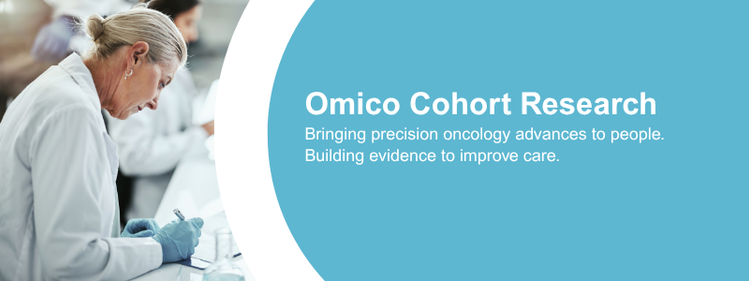
Omico has now reached 40,000 patient referrals across our research initiatives, with more than 35,000 Australians going on to participate in these initiatives.
Clinical trials testing new treatments might be what first comes to mind when we think of cancer research. But research takes many forms. At Omico, cohort research is central to our work.
Cohort research involves studying groups of people with shared characteristics or experiences, often over time, to understand patterns and outcomes. Omico's cohort research initiatives enable people with cancer, or at increased risk of cancer, to access advances in genomics and precision oncology, while helping us build evidence about how these approaches can improve care.
So, what does Omico’s cohort research look like in practice? - MoST – ~9,000 referrals
Australians with advanced or metastatic cancers who were taking or had completed their last line of effective treatment. MoST matched patients to precision treatments, extending lives for some, while building evidence that precision oncology can improve outcomes. - PrOSPeCT and CaSP – ~27,500 referrals
Australians with advanced, incurable or poor-prognosis solid tumour cancers. These programs provide comprehensive genomic profiling and treatment matching, while building evidence about how precision oncology can improve options and outcomes at national scale. - RiSC and SMOC+ – ~3,300 referrals
Our germline programs study people diagnosed with cancer at a young age or with multiple primary cancers, and people with an inherited increased risk of developing cancers in multiple organs. They have helped identify inherited cancer risk and investigate surveillance approaches to inform treatment, screening, risk reduction and earlier cancer detection. Together, these cohorts help us understand how precision oncology can reduce cancer risk, detect cancer earlier, provide more treatment options and improve outcomes – and build the evidence needed to translate effective approaches into routine cancer care.
More than 1,600 clinicians have referred patients to Omico. To every participant, clinician, researcher and partner who has contributed to this work: thank you.
| | | | | | | | | |
What can our genes tell us about how we respond to medicines?
A new Australian study involving Omico researchers has explored how genetic differences that affect our response to medicines can be identified using whole-genome sequencing.
Pharmacogenetics examines how inherited genetic variation can influence an individual’s response to medicines, including how medicines are metabolised, how well they work and the likelihood of some adverse effects. Understanding these differences has the potential to help clinicians select or dose certain medicines more appropriately for an individual.
Published in Frontiers in Pharmacology, the study analysed whole-genome sequencing data from 3,205 participants in the Medical Genome Reference Bank, a healthy older Australian reference cohort predominantly of European ancestry.
Researchers focused on 12 high-risk pharmacogenes with strong evidence linking genetic variation to prescribing decisions across medicines used in areas including cancer, cardiovascular disease, mental health, infectious diseases, pain management and anaesthesia.
Around four in ten participants carried at least one confirmed high-risk genetic configuration in genes known to influence individual responses to medicines. The study shows how common these genetic differences are in this group, providing a foundation for further research into what they may mean for people taking different medicines and how this knowledge could support more personalised prescribing.
The researchers also identified 140 previously uncatalogued predicted loss-of-function observations across the high-risk pharmacogenes, demonstrating the additional discovery potential of whole-genome sequencing compared with tests targeting only established variants. These findings provide new candidates for further investigation into how genetic variation may influence medicine response.
The research highlights both the potential of population-scale genomic data to deepen our understanding of medicine response and the work still needed to translate increasingly comprehensive genomic information into clinical care.
The study was led by Dr Kosar Hooshmand, with researchers from UNSW Sydney, the University of Sydney, St Vincent’s Hospital Sydney, Adelaide University and Omico. Omico’s A/Prof Mandy Ballinger and Prof David Thomas are co-authors.
📖 Read the paper in Frontiers in Pharmacology
| | | | | |
When genomic profiling points to an inherited cancer risk
The Precision Care Clinic (PCC) is a nationwide service that helps patients and clinicians understand and act on findings from comprehensive genomic profiling (CGP).
The Clinic provides oncology support to help clinicians interpret complex molecular findings and consider how they may inform treatment decisions. It also provides a specialist genetics service when CGP arranged through Omico’s Cancer Screening Program (CaSP) identifies a potential inherited genetic variant.
Sometimes CGP can identify a genetic change in cancer cells that raises the possibility of an inherited genetic change, known as a germline variant. If confirmed, this can mean the patient has an inherited increased risk of certain cancers, and because the genetic change can be passed through families, it may also have implications for family members.
The PCC genetics service provides specialist assessment and, where appropriate, arranges additional testing to determine whether a potential inherited variant identified through CaSP is actually germline. The service has now received more than 150 referrals from every state and territory, including a significant proportion from regional NSW, Queensland and Tasmania.
As access to CGP has become more widely available through Omico’s CaSP, timely access to genetics services for people with advanced cancer remains a challenge. The PCC supports access through bulk-billed telehealth and face-to-face consultations and facilitates appropriate testing.
| |
Not every potential inherited finding identified through CGP will be confirmed as germline. However, of the potential variants that have undergone follow-up testing through the PCC genetics service, 43% have been confirmed as inherited – highlighting the importance of appropriate follow-up when CGP raises this possibility.
Evaluation of the service is also finding that patients strongly value the opportunity to discuss their results with cancer genetics clinicians, particularly to understand what they could mean for their family members. Where appropriate, the PCC can facilitate predictive testing for relatives and connect families with local genetics services.
Learn more about the Precision Care Clinic and how to refer → Referring clinicians - Precision Care Initiative | UNSW Sydney
| | | | | | | |
GenesisCare and Omico partner to expand access to precision oncology
Precision oncology can only improve cancer care if people can access it.
Australians who are eligible for Omico’s Cancer Screening Program (CaSP) should have the opportunity to be referred, no matter where they are receiving their cancer care. Collaborations across the cancer care system can help make that possible.
| |
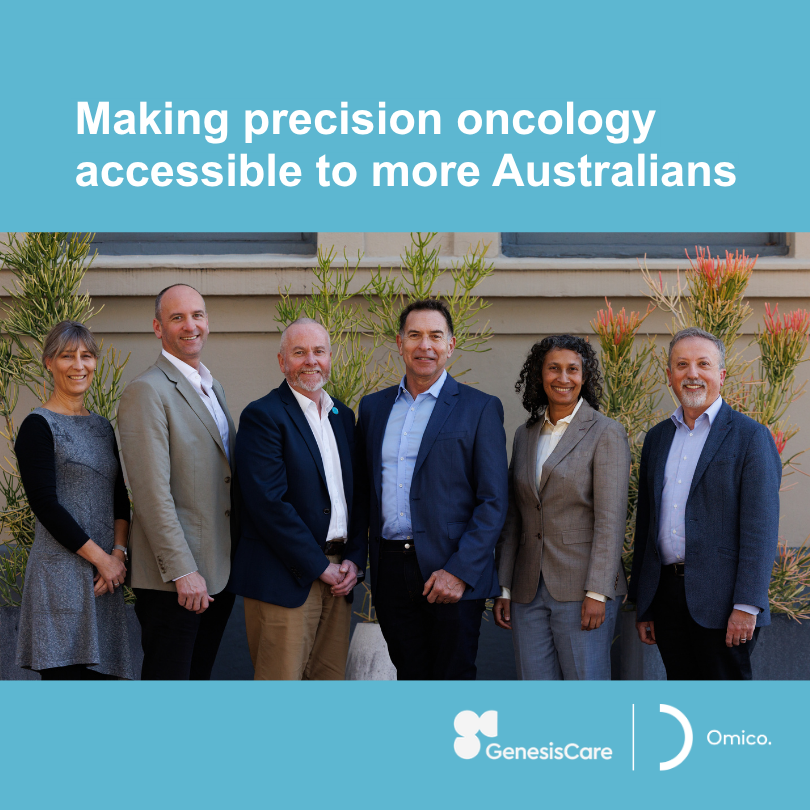
GenesisCare is partnering with Omico to support a coordinated approach to identifying and referring eligible patients at GenesisCare sites to CaSP, with the aim of making access more routine for patients who may benefit. The collaboration will also increase coordination around clinical trial opportunities.
Together, we aim to help more Australians with advanced, incurable or poor-prognosis cancers access precision oncology through CaSP, including comprehensive genomic profiling and matching to potential biomarker-led treatments and clinical trials, at no cost to patients. For some patients, this can uncover treatment options that may not otherwise have been identified, with the potential to extend lives.
Read our news story to learn more about this collaboration. |
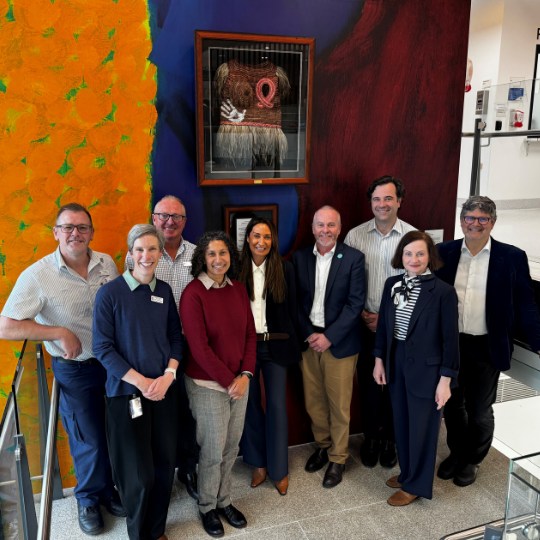
📸 L to R: GenesisCare’s Sonya McColl and Marcus Dreosti; Omico CEO Ian Black; GenesisCare CEO Richard Lizzio; Omico’s Lucille Sebastian; and GenesisCare’s Dr Tony Michele. | | | | | | | |
On the road in Dubbo: improving access to precision oncology
Some of the Omico team have been on the road, spending time with colleagues at the Western Cancer Centre in Dubbo to discuss how to support people facing cancer across Western NSW.
Being on the ground provides an important opportunity to hear directly from local clinicians and teams about the needs of their patients, and the opportunities and challenges in accessing precision oncology across the region.
| |
We share a commitment to ensuring people who could benefit from genomic profiling and treatment matching have the opportunity to access it — wherever they live, including Aboriginal and Torres Strait Islander people across the region.
Thank you to our Dubbo colleagues for the warm welcome, open conversations and strong engagement. These relationships and local insights are important as we continue working together to improve access to precision oncology for people with cancer across regional Australia.
📸 L to R: Tim Williams, Sandy Taylor and Rod Hammond, Western Cancer Centre/Western NSW Local Health District; Lucille Sebastian, Prof Maree Toombs and Ian Black, Omico; Dr Florian Honeyball, Western NSW Local Health District; and A/Prof Mandy Ballinger and Prof David Thomas, Omico.
| | | | | | | |
See what’s taking shape for APOS 27
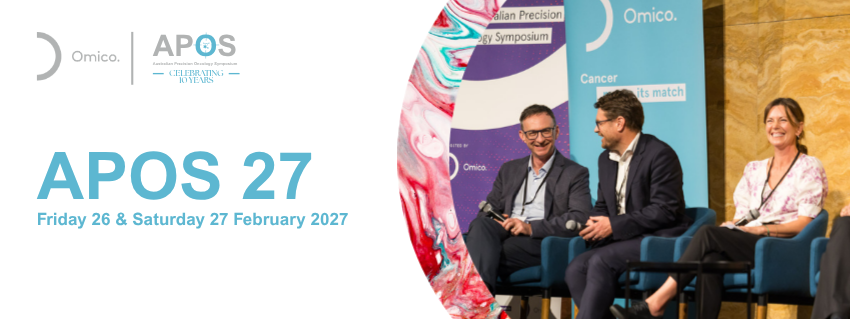
In 2027 on Feb 26 and 27, we’ll mark the 10th Australian Precision Oncology Symposium (APOS). The APOS 27 program snapshot is now available, offering a first look at what’s ahead.
In line with the theme The Next Horizons in Precision Oncology, the program will explore emerging therapeutic targets and treatment approaches, how AI is being deployed in oncology, the expanding role of germline genetics and pharmacogenomics, omics and new technologies, and more.
APOS is for Australian oncology professionals — including clinicians, researchers, pathologists, and those working across life sciences, advocacy and policy — interested in the latest developments in precision oncology and their application in research and cancer care.
| | | |
Registration opens in early November. Follow Omico on LinkedIn for new speaker announcements, program updates and registration news.
Sponsorship opportunities are also available for APOS 27.
📘 View the sponsorship prospectus
| | | | | |
What could Omico’s real-world data help you discover?
More than 100 people recently joined a webinar hosted by Omico and UNSW Centre for Molecular Oncology to explore our real-world data and biospecimen resources, and how they can support research and evidence generation.
Omico has built one of the largest and richest precision oncology real-world datasets, bringing together genomic, clinical, treatment and outcomes data from people who have consented to their data being used for research.
The right approach depends on the question you’re trying to answer.
Our RWD offerings range from an interactive subscription dashboard and targeted data analytics through to patient journey mapping, real-world evidence generation projects, external control arm analyses and secure direct data access.
Our interactive RWD dashboard now also has a name: REAL by Omico — Discover real-world precision oncology insights.
| |
REAL by Omico provides an aggregated, interactive view of Omico’s precision oncology data, enabling users to explore patient populations, cancer types, biomarkers, genomic alterations, treatments, outcomes and other variables to support questions across research and clinical development.
And demand for deeper analysis is growing. Our team is currently developing several new proposals with life sciences companies, tailored to the specific data and evidence needs of each organisation.
Want to understand what Omico’s RWD and biospecimen resources could enable?
▶ Watch our recent webinar on demand
▶ Explore Omico’s real-world data and biospecimens offerings
| | | | | | | |
What’s On: Upcoming Events & Learning Opportunities | |
Omico at ESMO 2026: research, collaboration and connection |
Omico is heading to Madrid for ESMO 2026, from 23–27 October, one of the world’s leading oncology congresses, bringing together the global oncology community across clinical research, drug development and precision medicine.
This year, Omico’s involvement in the scientific program spans real-world evidence and advanced data analytics, as well as equitable access to early-phase research.
Professor David Thomas will present Weighted 1:1 case-control matching with iterative resampling for pseudorandomised survival analysis. The research is co-authored by Omico’s Dr Ronald Chan and Melvyn Yap, together with Dr Damien Kee. Friday 23 October | 15:15–16:00 | Poster 4378P
Running alongside ESMO, the EONS19 Congress will feature collaborative work involving Omico and organisations across patient advocacy, research, healthcare, hospitals and industry, including Servier. Dr Ben Kong, a medical oncologist from Townsville, will present Advancing Equity Through Collaboration: A Patient-Centric Decentralised Model for First-in-Human (FIH) Studies as part of the scientific session Cancer Nursing: Equitable Health Care of Underserved Populations. Sunday 25 October | from 10:15
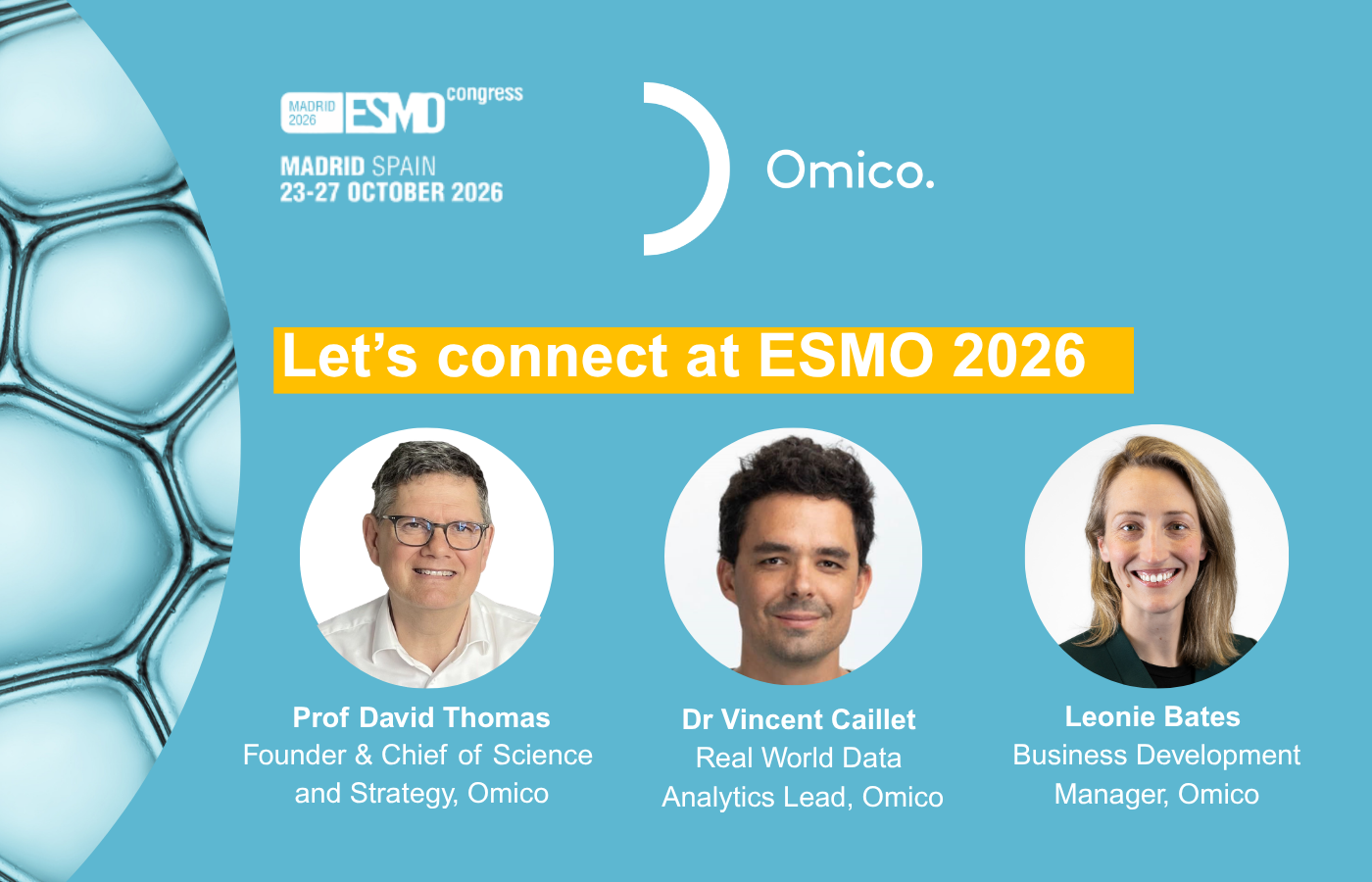
Along with Prof Thomas, also attending on behalf of Omico are Dr Vincent Caillet, RWE Lead, and Leonie Bates, Business Development Manager.
If you’re attending ESMO, we’d welcome the opportunity to connect — whether you’re interested in Omico’s real-world data and evidence-generation capabilities, clinical trial feasibility, our national precision oncology network, or opportunities to collaborate.
Connect with Omico at ESMO 2026 | |
Bringing genomics into routine healthcare: lessons from England |
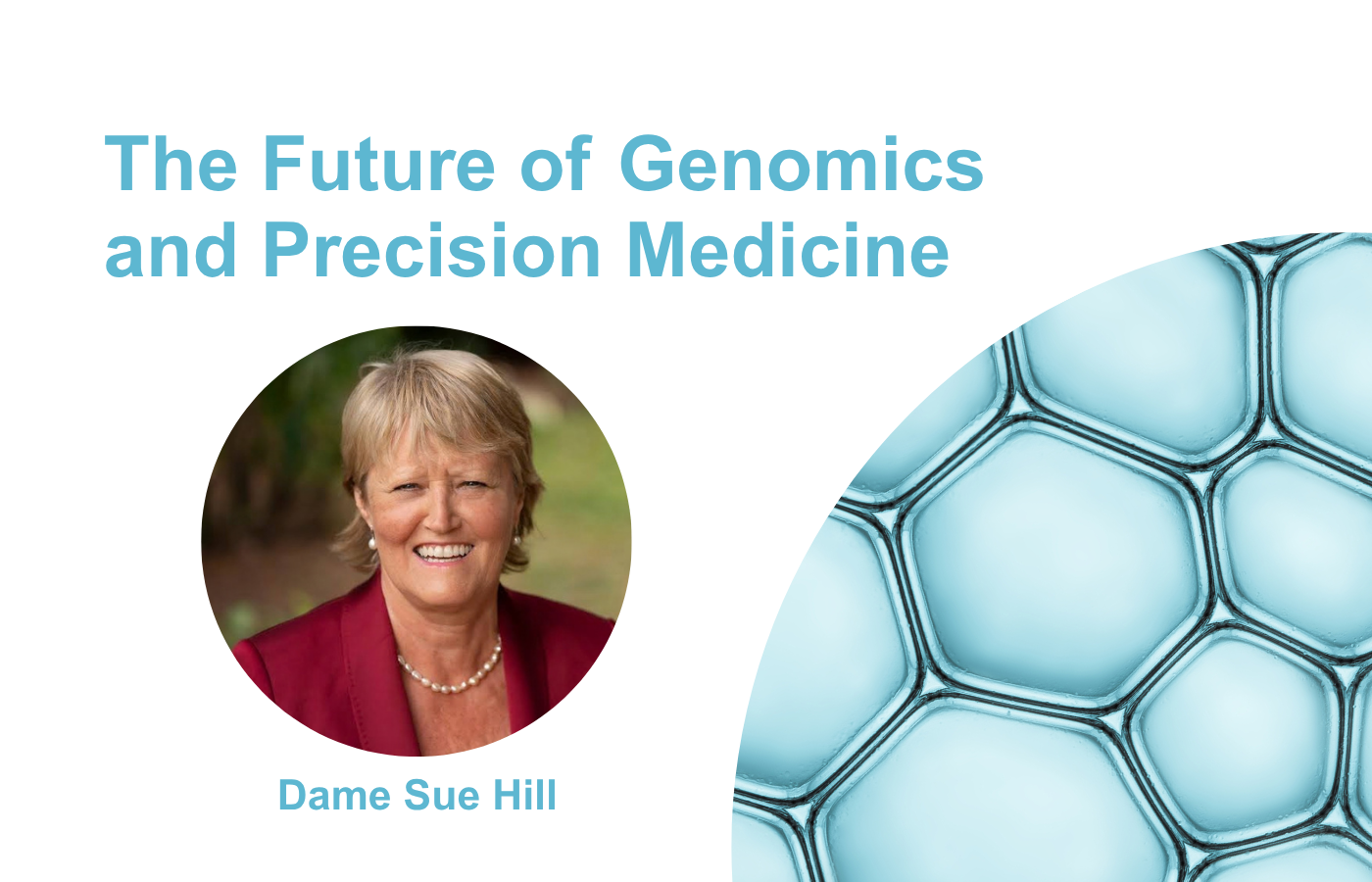
Professor Dame Sue Hill, Chief Scientific Officer for England and Senior Responsible Officer for Genomics in the NHS, will visit Australia in October, bringing valuable international experience in scaling clinical genomics and embedding it into routine healthcare.
Dame Hill is a global leader in the clinical mainstreaming of genomics. During her Australian visit, organised by InGeNA, she will engage with government, health system, industry, research and consumer leaders across Sydney and Canberra.
On 14 October, Dame Hill will address the National Press Club of Australia, Canberra, on Scaling Clinical Genomics: Lessons from the NHS for Australia. Omico is pleased to be an event partner, supporting this important national discussion about scaling genomics in Australia.
Scaling Clinical Genomics: Lessons from the NHS for Australia 📅 Wednesday 14 October
⏰ 5.00–6.30 pm
📍 National Press Club of Australia, Canberra 👉 Book tickets
A public event in Sydney on 15 October will provide another opportunity to hear directly from Dame HIll about practical lessons from England’s experience of scaling clinical genomics and the insights this offers for Australia.
The Future of Genomics and Precision Medicine 📅 Thursday 15 October
⏰ 2.00–4.30 pm
📍 Amazon Web Services, 2 Market Street, Sydney 👉 Register to attend the Sydney event
Genomics is already providing new ways to understand disease and inform care. The challenge now is implementation: how we move beyond research and individual initiatives to make genomics part of routine healthcare at scale.
Learning from health systems that have already taken significant steps towards mainstreaming genomics can help inform Australia’s approach, including the opportunities, challenges and practical considerations involved in implementation.
We acknowledge InGeNA for arranging Dame Hill’s Australian visit and creating these opportunities to learn from international experience and advance the conversation about implementation in Australia.
| | | | | | | |
Presentation worth revisiting | | | |
Connecting the Pieces: Insights from CanForum26
At Rare Cancers Australia’s CanForum26, Professor David Thomas explored what needs to change to close the gap between scientific discovery and equitable access to precision cancer treatment.
His presentation looked at system-level opportunities including expanding clinical trial capacity and developing a national Learning Health System that better connects clinical research, real-world evidence, treatment access and outcomes.
As David put it, “The pieces already exist — what is needed is a way to connect and harness them.”
Got eight minutes? Watch David’s CanForum26 presentation
Thank you to Rare Cancers Australia for creating space at CanForum26 to discuss not only the challenges facing people with rare and challenging cancers, but the system-level changes that could help address them.
| | | | | |
Keeping precision oncology access on the agenda
We want more Australians to understand what precision oncology is, and what it can offer people facing cancer. Industry awards provide another opportunity to take that message beyond the cancer sector and reach new audiences.
| |
In September, Omico and our PR agency Cube received Bronze at the Golden Target Awards for our public affairs and advocacy work. In November, we are finalists together in the PRIME Awards for Protecting access to precision oncology for Australians with incurable cancer. Omico is also a finalist in the Health Industry Awards for NGO of the Year.
These acknowledgements reflect work that is never done alone. Thank you to our Omico team, partners, collaborators and advocates, and to the patients and families at the heart of our work.
| | | | | | | |
We hope you enjoy this update. Feel free to share it with colleagues and friends and invite them to [subscribe here]. | | | | | | | | | |
Omico (Australian Genomic Cancer Medicine Centre)
You have received this email because you have previously provided your email address to Omico. You can Unsubscribe
a: Hilmer Building (E10), Union Road, UNSW, Kensington NSW 2052 t: 1800 954 350 e: contact@omico.org.au w: omico.org.au
View our Privacy Policy
| | | | | | | |